Finding the balance
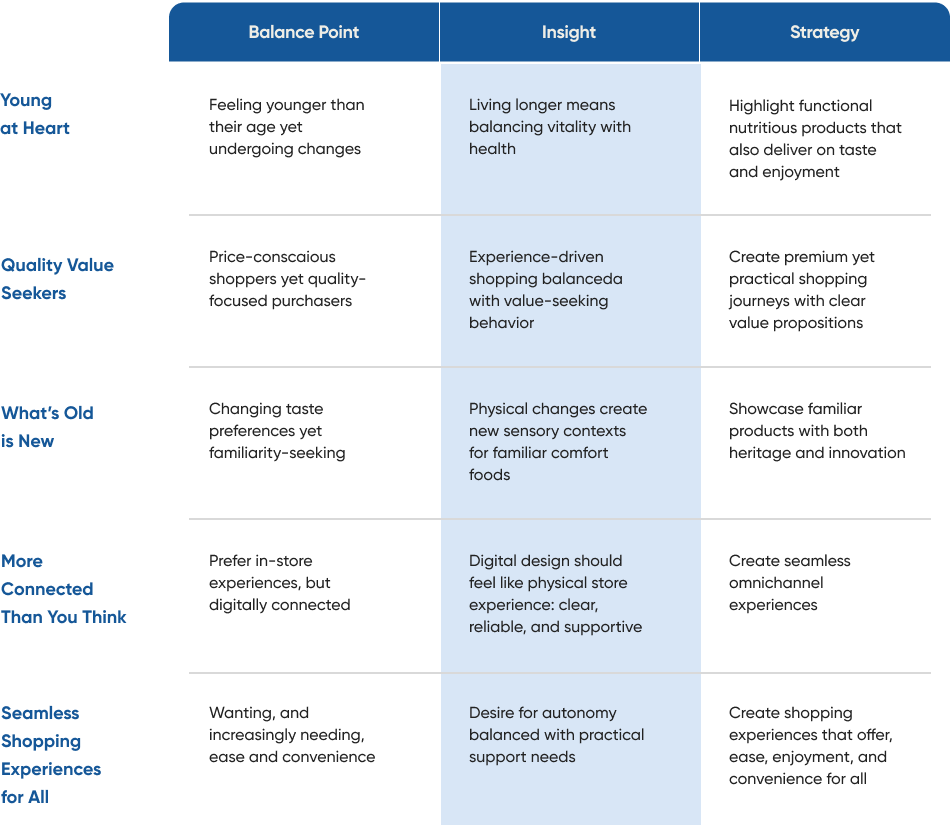
Successfully engaging Aging Shoppers requires navigating these key tensions by finding strategic ways to reconcile these shoppers' distinct, sometimes competing, needs. As we also saw with Gen Z (read the article HERE) these aren't so much "contradictions" as nuanced and at times complex dynamics that must be understood and balanced.
Let's discuss five of these critical "balance points."
Balance Point #1
Young at Heart
Insight:
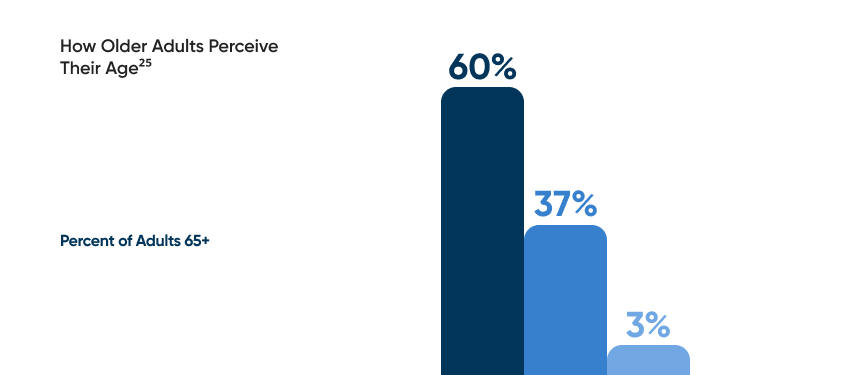
They often feel younger than their age and take active steps to feel and stay healthy.
Eighty-six percent of Aging Shoppers say good health is core to a good life.23 And they make their food and beverage choices towards that end. Proprietary PepsiCo research confirms that Aging Shoppers are 24 points more likely than the general population to link snacking to "keeping my brain and body sharp" and 62% directly link their energy levels to what they eat and drink.24
Strategy:
Bridge vitality and health. Offer functional products that don't compromise on enjoyment. Feature products that support brain, joint, and heart health while respecting comfort rituals. Think indulgence and intention.
Balance Point #2
Quality Value Seekers

Insight:
They're highly conscious of value and inflation but also prioritize quality and trusted brands more than younger shoppers.26
Aging Shoppers are 15 points more likely than Gen Pop to say they plan grocery trips to "stretch their money across more meals and snacks" and are 17 points more likely than Gen Z to check unit pricing and 29 points more likely to clip coupons.27
But pepviz data also shows they rank "Gives me the best quality products for my budget" (Index 172) as the most important driver for choosing a retailer. And, once they discover the right balance of quality and value, they are also less likely than the general population to switch brands just to save money (Index 84).28
Finally, Aging Shoppers tend to think of loyalty in terms of value-added rewards and are more likely to say "rewards my loyalty with special offers and deals" is a significant choice driver (Index 129).29
Strategy:
Offer premium yet practical value. Highlight quality cues, reliability, and leverage brand trust alongside clear price benefits. Balancing premium cues with visible value (on-pack, online, and in display) is key to driving trade-up and loyalty.
Balance Point #3
What's Old is New
Insight:
Physical changes can alter sensory experiences, yet the comfort of familiar foods remains important.
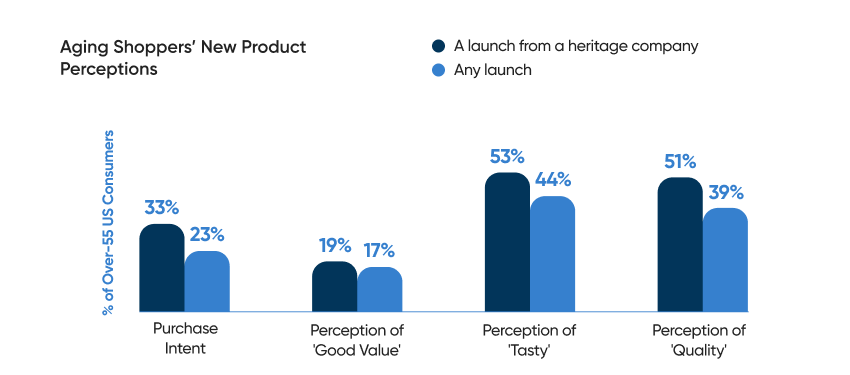
Forty-seven percent of Aging Shoppers say they seek foods that remind them of family meals growing up (that's 2X the nostalgia index of our famously “newstalgic” Gen Z cohort.) At the same time 33% say they're excited to try new global flavors.30 Over half of shoppers over 65 describe themselves as someone who is loyal to specific brands, compared to just 39% of 18-44-year-olds. And shoppers over 55 rate new product launches from heritage food & beverage companies higher, because they believe that well-known brands will be tastier and better quality.31
Strategy:
Celebrate the familiar while surfacing thoughtful innovation (especially around health benefits). Heritage brands and formats can serve as foundations for health-forward, flavor-forward reinvention. Reinforce via loyalty programs and promotions to turn old habits into new ones.
Balance Point #4
More Connected Than You Think
Insight:
They aren't technophobes. However, they are more skeptical of tech than younger groups and less likely to rapidly adopt unproven tech.32
While not born “digitally native” this cohort played a key role in creating the foundation of the digital world. And they're deeply digitally engaged: 89% of today's 50–64-year-olds own smartphones, and 73% use laptops or desktops.33 So while 78% of Aging Shoppers prefer shopping in-store for groceries, 45% use digital flyers and 44% also shop online for convenience.34
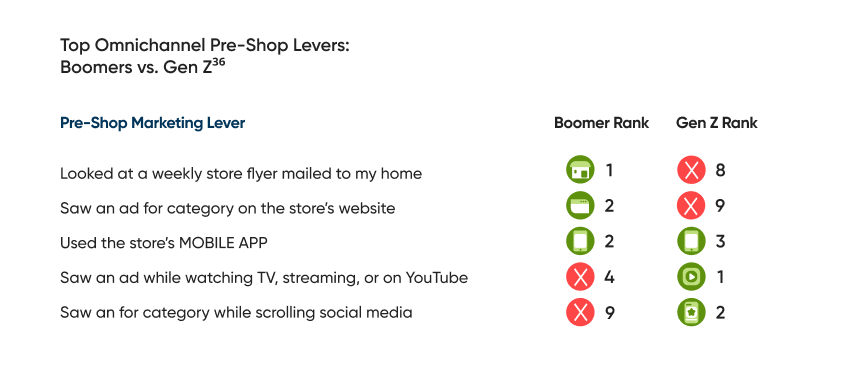
Aging Shoppers are 15 points more likely than average Americans to appreciate "online shopping sites that feel like the physical store layout." Their top choice driver for apps and websites is that they be "easy to use" (50% pick as #1) and they over index vs. younger shoppers on the importance of having “few or no out of stock option” online (174 Index).35 So when designing omnichannel pre-shop strategies, remember that Aging Shoppers will be more likely to rely on traditional media like mailed flyers and ads on store websites than on social and streaming media, but that mobile serves as a critical connection point across shoppers of all ages:
Strategy:
Create seamless omnichannel experiences blending digital convenience (simple interfaces, useful tools like online list-building) with a strong, socially engaging in-store environment. Ensure online service is reliable. Digital design should feel like their physical store: clear, reliable, and supportive.
Balance Point #5
Seamless Shopping Experiences for All
Insight:
Making the shopping experience easy and convenient for Aging Shoppers is something everyone can benefit from.
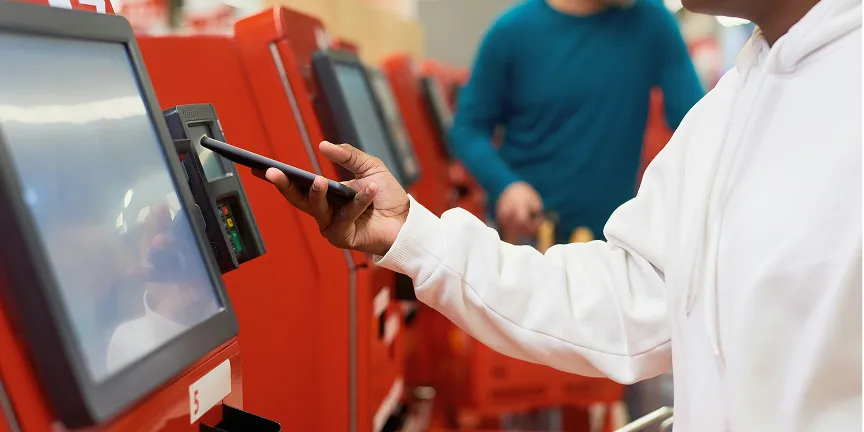
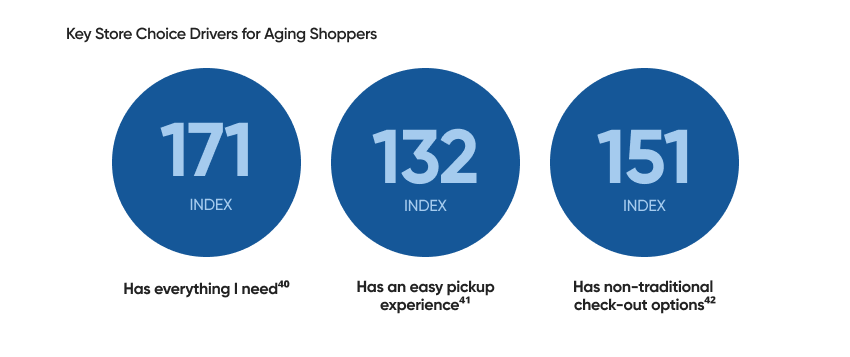
Aging Shoppers say they feel confident shopping solo,37 and are 10pts more likely than Gen Z to prefer self-checkout.38 pepviz data shows "Has everything I need" (Boomer Index 171), having non-traditional checkout options like “smart” shopping carts or scan-and-go (Index 151), and easy pickup experience (Index 132) are key drivers, alongside feeling safe (Index 132).39
Convenience preferences (nice to haves) can become accessibility mandatories (must haves) as we age. If you only have time and energy to go to one store, "has everything I need" isn't just the difference between a convenient and inconvenient shopping outing – it may be the difference between a successful trip and a failed one.
Strategy:
But you know what? Accessibility and convenience aren't just benefits for older shoppers. They can be best practices for all ages, just like non-traditional check-out options like "smart" shopping are top preference drivers for shoppers of all ages. So seek out ways to make the shopping experience more seamless for older shoppers in ways that add to the ease, enjoyment, and convenience of all shoppers.